Currently, the main commercial magnetometers on the market include fluxgate magnetometer, proton magnetometer, and Overhauser Magnetometer, optically pumped magnetometer and superconducting quantum interference magnetometer. Marine magnetometers and ground magnetometers have low requirements on the weight of the equipment and have relatively slow moving speeds. You can use fluxgates, protons,/overhauser, optically pumped magnetometer. Proton Magnetometer and Overhauser magnetic forceDue to inherent limitations such as working mode, gradient tolerance, and sampling rate, the instrument is rarely used for aeromagnetic measurement.Aeromagnetic measurement is limited by the detection principle, probe material, volume, weight, sampling rate,Due to the constraints of many factors such as price, commercial aeromagnetic measurement is mainly based on optical pump magnetometer, and fluxgate magnetometer is used as compensation or supplemented by three-component measurement. Especially drone aeromagnetic, which has a strong impact on the magnetometerThe requirements for weight and installation position are higher, and the integration work is far more difficult than that of traditional manned aircraft.
Aeromagnetic survey was first used by the Navy to detect magnetic anomalies caused by submarines, and was later used for civil aeromhysical exploration. In the field of physical exploration, aeromagnetic survey has the characteristics of fast speed, high accuracy, and no interference from the surface. It has been used in geological mapping, large-area geological structure research, evaluation of iron ore and other metal ore mineral resources, and prediction of oil and natural gas metallogenic prospects.,It is widely used in engineering geology and environmental monitoring. In the past, aeromagnetic surveys were carried out on fixed-wing aircraft or helicopters, but the cost of aerial surveys was high. In order to obtain high-quality data, low-altitude flying posed huge risks, and the flying altitude was too high, which reflected the difference of geological effects.The rate is low and it is impossible to carry out large-scale work.
Secondly, since most of the aircraft materials are metal, they are more or less weak magnetic. The magnetic field generated by the movement of the engine rotor during flight and the induced magnetic field generated by the electrification of the avionics system in the aircraft can interfere with the magnetometer. In order to allow the aircraft to carry a pumped magnetometer and obtain effective data,1944 by Tolles of the U.S. Navy Department AndLawson(1944) gives andWorking model of interference fields related to aircraft maneuver. They compared aircraft magnetism related to aircraft maneuverThe field is divided into a constant magnetic fieldHp(Permanent field), induced magnetic fieldHi(Induced field) and vortexcurrent magnetic field Hc(Eddy-current field)。Constant magnetic fields refer to magnetic components and components on aircraftProduced by the residual magnetism of ferromagnetic materials. The induced magnetic field is mainly generated by the magnetization of the soft magnetic material on the aircraft body in the geomagnetic field. The size of this magnetic field is proportional to the external magnetic field that causes it. Therefore, in the three-axis fluxgate sensor coordinate system, the magnitude and direction of the induced magnetic field will change with the attitude of the drone. The eddy current magnetic field is a metal body that cuts the geomagnetic field during flightEach component is proportional to the rate of change of the geomagnetic field projected on each coordinate axis.
Leliak theoretically demonstrated this model in 1961, and expressed the optically pumped aeromagnetic compensation method into the following theoretical formula:
HT = c1 cos X + c2 cosY + c3 cos Z
+H {c4 os 2 X + c5 cos X cosY + c6 cos X cos Z +c7 cos2 Y + c8 cosY cos Z + c9 cos 2Z} +He {c10 cos X (cos X )¢ + c11 cos X (cosY )¢ + c12 cos X (cos Z )¢ +c13 cosY (cos X )¢ + c14 cosY (cosY )¢ + c15 cosY (cos Z )¢+c16 cos Z (cos X )¢ + c17 cos Z (cosY )¢ + c18 cos Z (cos Z )¢} formula 1
HT Refers to interfering with the magnetic field,He Refers to the earth's magnetic field,(cosX, cosY, cosZ) is with flyingThe three components of a three-axis fluxgate with fixed actuator position correspond to the cosine of its axial direction,()'meansRate of change of the cosine of the magnetic field direction projected onto each coordinate axis.c1- c18 is 18 estimated parameters. itsMediumc1- c3 Interference with constant magnetic fieldHp About,c4- c9 Related to induced magnetic field interference, c10- c18Related to eddy current magnetic field interference.
1980 YearLeach Through further research, the process of solving model compensation coefficients is regarded asSolving the linear equations improves the stability of the solved coefficients. With the development of computers and the advancement of high-precision aeromagnetic detection, magnetic compensation has developed from hardware feedback coil model to software.Mature commercial products for real-time, post-flight compensation.
Aeromagnetic measurement methods for manned spacecraft generally use an optical pump magnetometer as the total field magnetometerfor data collection. If the magnetometer and the aircraft are hard-connected, a three-axis fluxgate magnetometer needs to be used to record the flight attitude. First perform high-altitude four-sided maneuver flightTo obtain the direction cosine generated from the total field of the optically pumped magnetometer and the three-axis fluxgate vector magnetic field dataParameters, the compensation estimation parameters are obtained by filtering and solving the linear equation, and then the series of estimated parameters are used to compensate and calculate the data in actual working measurements to remove the optical pumping magnetic field of the aircraft.Magnetic interference caused by the force meter.
In the optically pumped aeromagnetic compensation system, the three-axis fluxgate magnetometer is only used to record flight attitude and obtain directional cosine parameters, and is not used to calculate the total geomagnetic field data. Since the zero-bias error and sensitivity error of the three-axis fluxgate itself are not considered, the probe's ownhard iron(hard-iron)and soft-iron effect and three-axis non-orthogonal errors, whileformula 1 Solving the multivariate linear regression equation between the directional cosine generated by the mid-three-axis fluxgate data and the geomagnetic total field calculated by its own three-axis vector magnetic field will cause serious multicollinearity problems.Question, so use the optical pump magnetic compensation formula 1 It cannot be effectively applied to the vector magnetic field and geomagnetic total field data correction and compensation algorithm models of three-axis fluxgate magnetometer.

With the maturity of application technology, the application of drones in aeromagnetic survey has increased significantly, and noMan-machine mounted aeromagnetic measurement equipment can be quickly deployed, efficiently and accurately collect data, and openLarge-scale aeromagnetic operations can not only eliminate interference such as the ground and surface and undulating terrain.The impact of life, fully saves costs, and can also undertake detection based on the best terrain space in an environment where geological environment and safety standards prohibit manned aircraft magnetic measurement systems.The mission can even provide better quality detection data than the manned spacecraft aeromagnetic system.
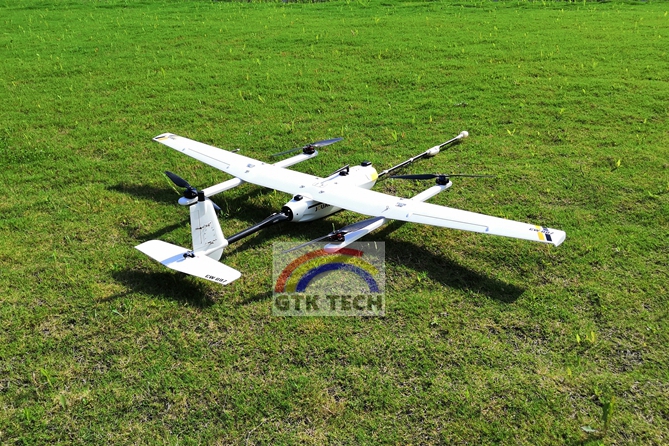
Due to its particularly sensitive characteristics to magnetic components, the aeromagnetic system has special requirements for the platform selection of drones. The low magnetism, flight characteristics and battery life of drones are one of the key factors in actual aeromagnetic operations. At present, the types of drones on the market can be roughly divided into single-rotor, multi-rotor and fixed-wing drones. Single-rotor drones have a complex structure, numerous parts and components, very high research and development costs, very long cycles, inconvenient maintenance, and high requirements for operators. Multi-rotor drones are easy to control and produce, but the biggest problem is their poor endurance, and their flight distance and range are also greatly limited. Although ordinary fixed-wing drones have strong endurance and faster speeds, both take-off and landing require flat terrain or a dedicated runway. They are obviously not a suitable choice for geophysical prospecting services such as mineral exploration that require field operations. At present, vertical take-off and landing fixed-wing drone forms have appeared in the market and technical fields. Based on conventional fixed-wing aircraft, multi-axis power units are added to fly or hover in multi-axis mode under take-off and low-speed conditions, while in level flying. In the state, flying in fixed-wing mode, gravity is overcome through aerodynamic lift, which greatly improves flight time and speed. However, due to the need to add multiple magnetic devices such as motors, electronic regulators and other equipment. Vertical take-off and landing fixed-wing drones equipped with aeromatics require certain layout design, selection and modification to meet the requirements. Currently, there is no specific target for aeromatics on the market.Systematically designed vertical take-off and landing fixed-wing drone.
Previous aeromagnetic systems needed to includeGPS, optical pump magnetometer, three-axis fluxgate magnetometer, collectors and other devices, their volume is large, and the total weight is generally 5kg above. Therefore, the load capacity requirements for drone platforms are high, and most of the ones used in the market are expensive tens of millions of dollars.hundred10,000-level large-scale fixed-wing drone platform, or unmanned helicopter platform.Secondly, many commercial optically pumped magnetometers and aeromagnetic compensation equipment rely on imports, and the prices are extremely high.It is expensive, and at the same time, the mainstream high-precision optical pump magnetometer on the market is sensitive equipment and is subject to import restrictions.For people.
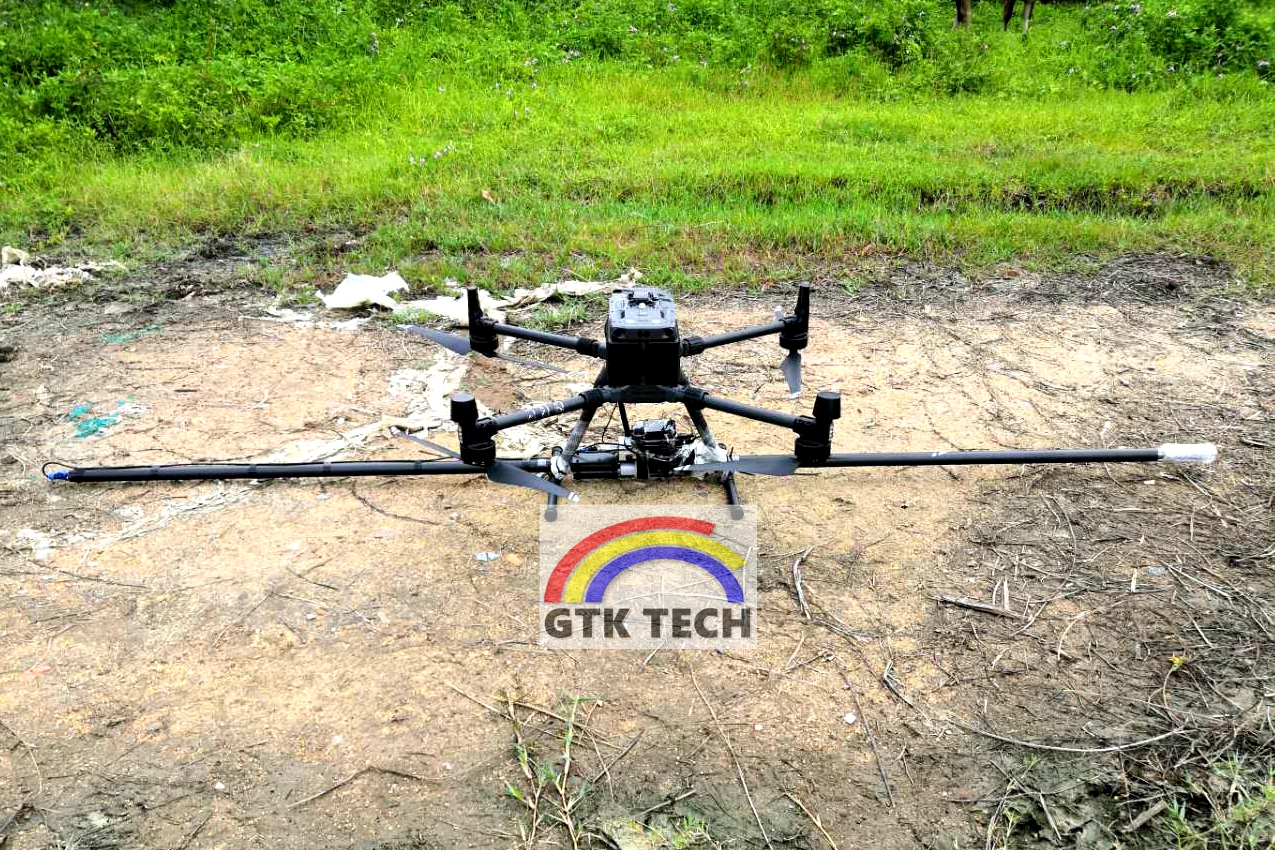
Moreover, according to current relevant national laws and regulations, the weight of an empty aircraft is greater than 4kg, and the take-off weight is greater than 4kg.(include a battery)greater than 7kg of drones belonging toII UAVs above class, whether or notFlying within the line-of-sight requires prior application for airspace. For those below this weight requirement, flying within suitable airspace and within the line-of-sight range, there is no need to apply for airspace in advance, and only need to be reported to the supervision platform in real time. The above conditions greatly limit the promotion and application of drone optical pump magnetometer aeromagnetic measurement systemsAt present, the main research and technology are concentrated in national projects such as universities and national scientific research institutes. A truly fully market-oriented and production-oriented platform has not yet emerged. Catalco launched aThe GTK-M300 multi-rotor drone aeromagnetic system and the GTK-R007 vertical-lift fixed-wing drone aeromagnetic system, both of which have a total take-off weight of less than 7Kg.
Double compensation technology for aeromagnetic optical pump and fluxgate
Gateko(Shenzhen)Technology Co., Ltd. Aeromagnetic compensation for GTK-RB-COMP droneThe system integrates high-precision rubidium optical pump magnetometer and high-precision fluxgate three-component magnetometer,GPS, Laser altimeter,9 Axis attitude sensor, using industry mature fixed-wing aeromagnetic compensation technology andCombining its own invention patented compensation technology, using aeromagnetic optical pump and fluxgate dual compensation technology, real-time or post-flight compensation methods to maneuver the aircraft.During travel, the interference generated by the two magnetometer probes is removed by software compensation.
Optical pumping compensation technology
Software compensation method is used to compensate aeromagnetic survey data. The system uses the three components of the vector magnetometer as attitude factors to remove the permanent magnetic field, induced magnetic field and eddy current magnetic field of the aircraft from the total field through algorithms.In a gentle magnetic field area as far away as possible from the ground, 18 coefficients were estimated based on data from previous four-sided flights. During subsequent actual work survey flights, the collected data was processed using 18 memory term coefficients.
fluxgate compensation technology
The 12-parameter digital compensation algorithm for fluxgate magnetometer obtains 12 correction parameters for axial interference, scale coefficient, orthogonality error and software effects, and can compensate the total field output by the fluxgate magnetometer in real time.
